
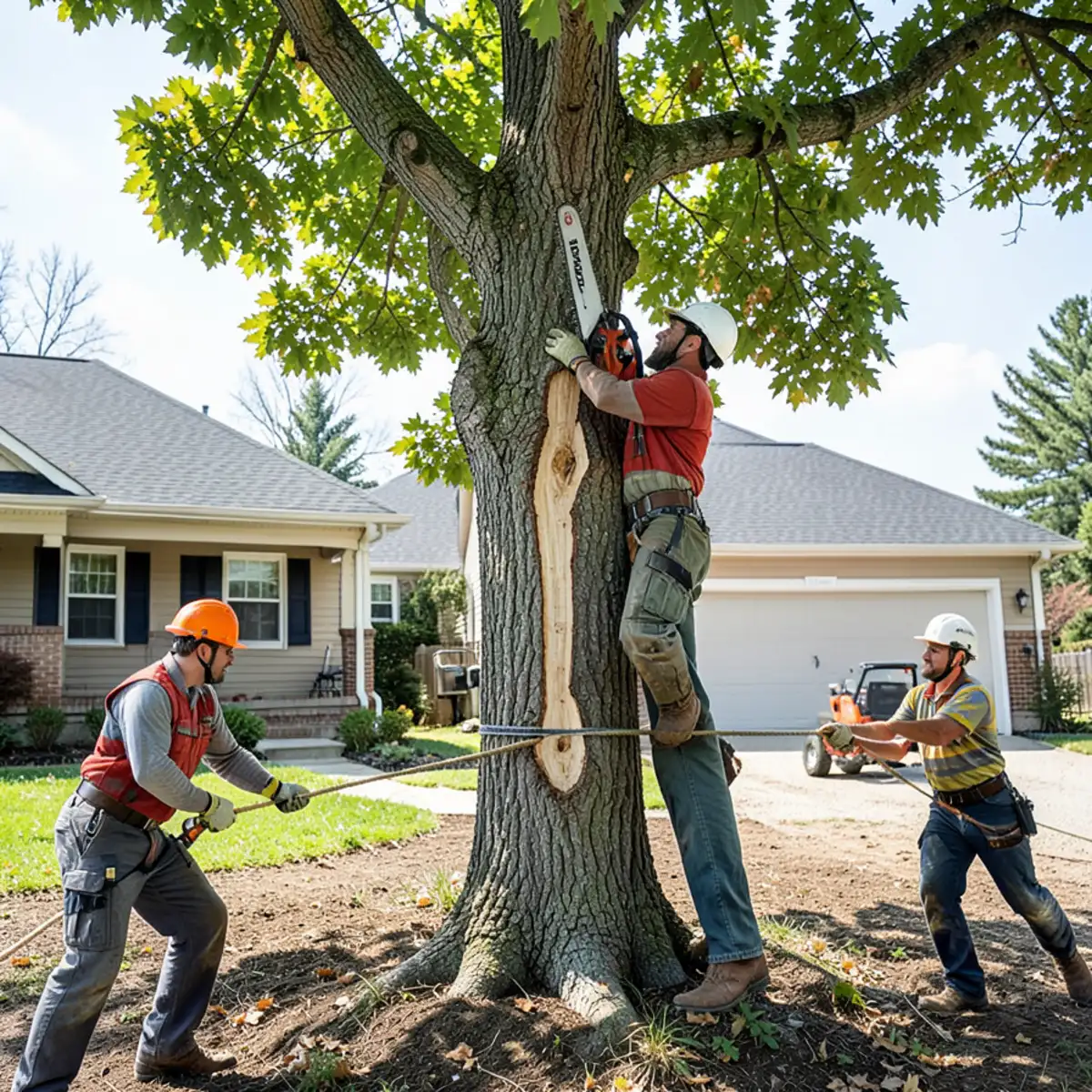
Safe, Controlled Takedowns for Hazardous & Declining Lansing Trees
Tree removal (tree felling) in Lansing, MI typically costs $627 to $729 per tree for an average residential project, according to published Homeyou project benchmarks from 936 Lansing-area properties. Small trees under 30 feet start near $300, while mature 60-to-90-foot canopy trees reach $1,500 to $3,500 depending on height, equipment access, proximity to structures, and nearby overhead power lines. Professional tree removal is the disciplined felling, rigging, lowering, chipping, and haul-away of dead, hazardous, or storm-damaged timber.
Taking down a mature shade tree in Lansing requires an understanding of urban lot layouts, mature canopy age, and municipal utility corridors. Much of Lansing's housing stock in neighborhoods like Old Town, Moores Park, REO Town, Groesbeck, Colonial Village, and the Westside was constructed prior to 1960. Properties feature tight side-yard setbacks, detached single-car garages built directly along property lines, and overhead secondary utility drops. When a 70-foot tree begins to fail, there is no open field to drop it into; every branch must be methodically lowered under tension.
Total Tree Maintenance operates from our local hub at 3105 S Martin Luther King Jr Blvd. We handle removals for dead ash trees killed by emerald ash borer, structurally compromised silver maples with splitting trunks, and storm-damaged hardwoods overhanging slate and shingle roofs. Our work follows strict ANSI Z133 safety procedures, ensuring drop zones are secured, property is shielded with composite turf mats, and every cut is accounted for before the saw engages.
If a tree on your property is actively leaning against a house, garage, or vehicle, or touching overhead wires, stay clear immediately. Tree work within 10 feet of energized lines falls under OSHA standard 29 CFR 1910.333, requiring specialized utility clearance protocols before cutting.
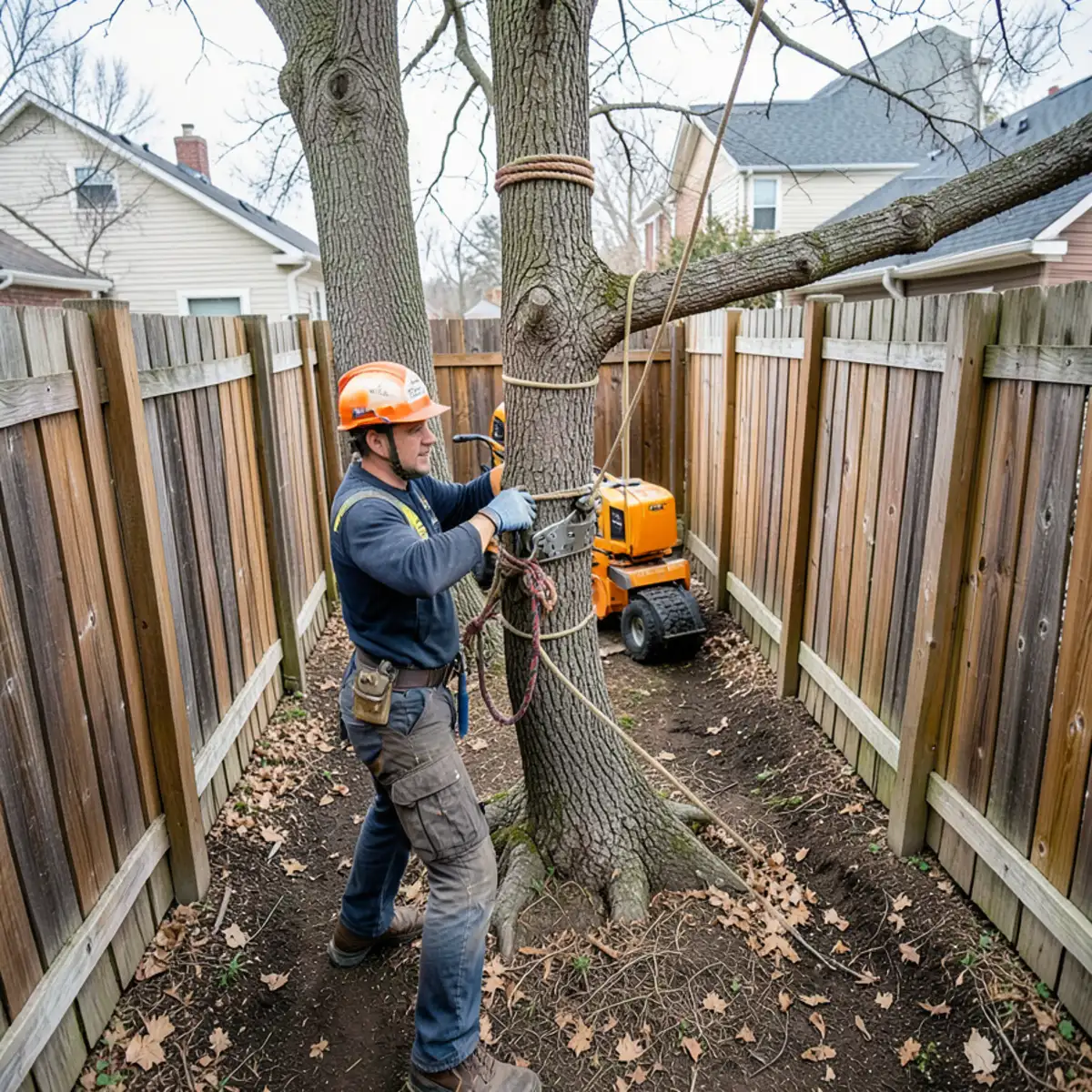
How Much Does Tree Removal Cost in Lansing, MI?
Tree removal in Lansing costs between $627 and $729 for a typical residential shade tree. The final price breaks down into three core elements: tree size (height and trunk diameter), physical site complexity (access and power lines), and service add-ons such as stump grinding and complete debris hauling.
Height and trunk diameter set the baseline because they directly determine crew hours, rigging complexity, and wood haul volume. Homeyou data from 936 Lansing projects indicates a medium tree typically ranges from $576 to $781, while Today's Homeowner reports a regional average near $560 for Lansing. The table below outlines size-based contractor estimate ranges and primary cost drivers across Ingham County:
Need Professional Tree Removal in Lansing?
Call our local dispatch directly at (321) 677-9055. Free on-site evaluations and itemized written estimates.
Lansing Hub
3105 S MLK Jr Blvd
Transparent Pricing
Free Itemized Written Scope
Safety First
ANSI Z133 & MISS DIG 811
Storm Ready
Fast Local Crew Dispatch
What Factors Change a Tree Removal Quote in Lansing?
Six primary variables move a Lansing tree removal quote more than tree height alone. Understanding these factors helps you evaluate competing estimates accurately:
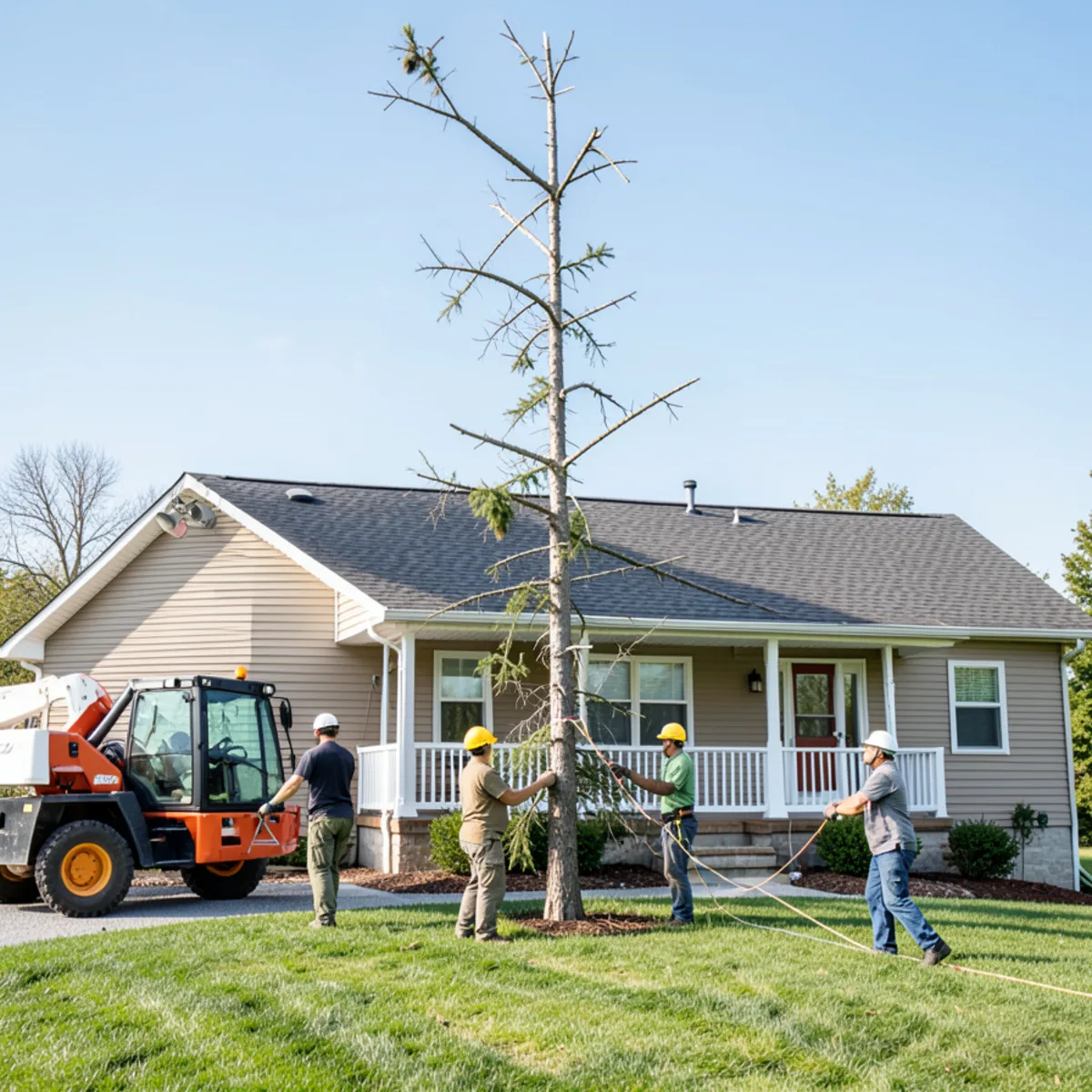
Technical Execution
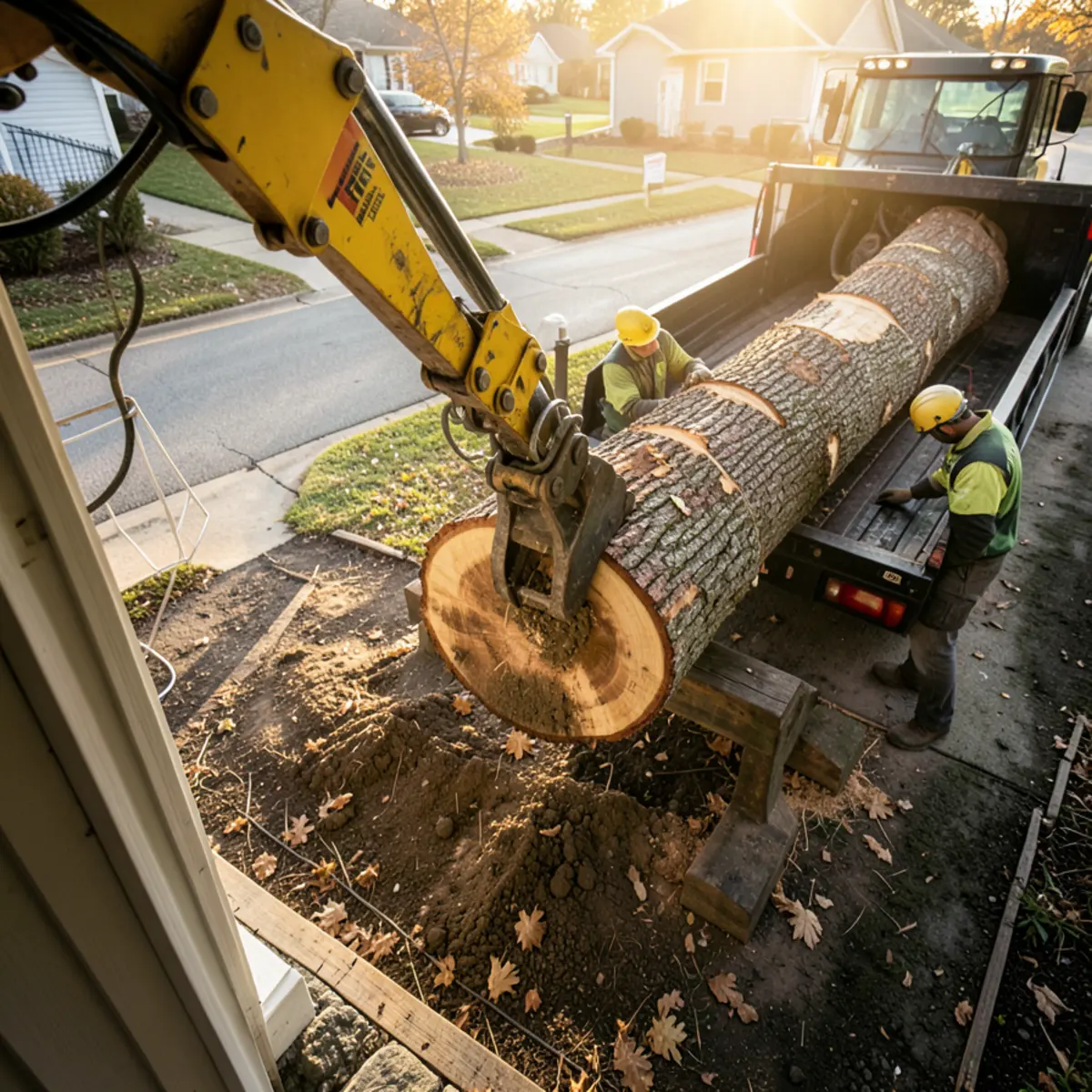
Utilizing specialized equipment for safe residential property access.
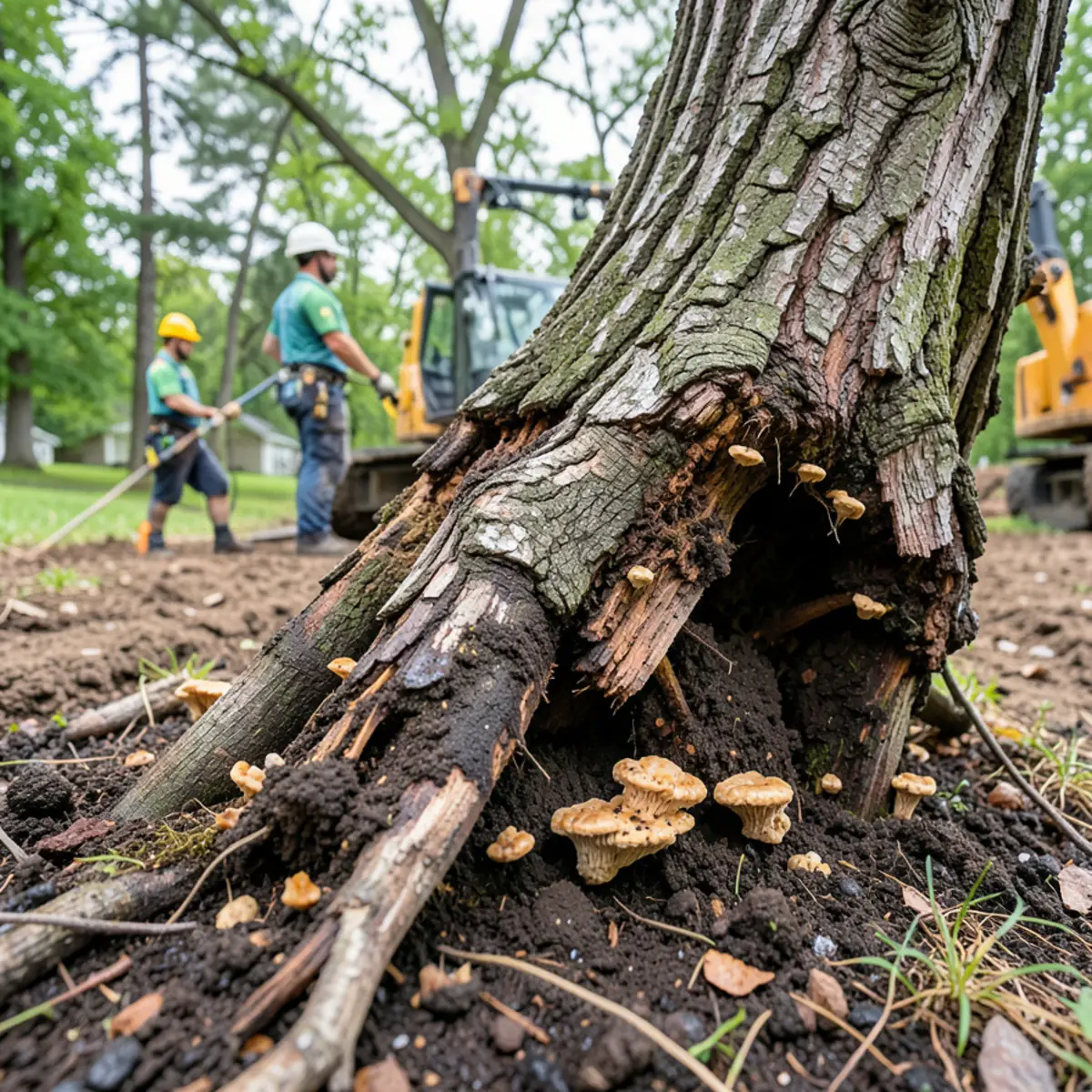
Site Protection
Protecting turf, structures, and utilities throughout the operation.
Why Do Published Lansing Tree Removal Prices Disagree?
Homeowners researching tree removal costs in Lansing frequently encounter conflicting figures online. For example, Manta reports costs ranging from $206 to $1,343 for Ingham County, Today's Homeowner cites $215 to $887, while local tree companies frequently quote $500 to $2,800 for complex residential takedowns.
These discrepancies exist because different sources measure different scopes. Low-end figures ($200 to $400) reflect simple curbside felling of small ornamental trees where brush is left for municipal curbside pickup, or fixed-rate contractor fees (such as ProMatcher's 2021 survey in ZIP 48924) that explicitly exclude stump grinding, permits, and emergency response. High-end figures ($1,500 to $3,500) represent large 80-foot hardwoods overhanging dwellings, requiring commercial cranes, traffic control, and full timber haul-away.
To protect your budget, never rely on ballpark phone numbers. Always request a free, written, itemized estimate that details removal, stump grinding, debris hauling, and property protection line by line.
What Credentials & Insurance Should a Lansing Tree Removal Company Show?
A critical consumer reality in Michigan is that the state does not issue a specific state contractor license for tree removal. While residential builders and electrical contractors hold state licenses, tree care companies operate under general business registration. Consequently, homeowners must verify three independent credentials to ensure they are not held financially liable for property damage or worker injuries:
- ISA Certified Arborist Credential: International Society of Arboriculture (ISA) certification verifies extensive training in tree biology, safe rigging physics, and diagnosis. Ask for the arborist's certification number and verify it on the official ISA database.
- ANSI Z133 Safety Standard Compliance: The American National Standards Institute ANSI Z133 establishes mandatory industry safety requirements for pruning, repairing, maintaining, and removing trees. It governs chainsaw operation, helmet and eye protection, and drop-zone perimeters.
- OSHA Line-Clearance Qualification: Required under OSHA 29 CFR 1910.333 and 1926.416 whenever tree work occurs within 10 feet of overhead high-voltage utility lines.
- Certificate of Insurance (COI) Direct from Carrier: Never accept a photocopied paper certificate handed over by a crew member. Require that the insurance agency email an active COI directly to you showing at least $1,000,000 to $2,000,000 in general liability.
- Workers' Compensation Coverage: Mandatory proof protecting you from catastrophic personal injury lawsuits if a tree worker slips, falls, or is injured on your property.
5-Step Checklist: How to Check a Tree Service Quote Before Signing
Before authorizing any tree cutting on your Lansing property, walk through this 5-step verification process to prevent surprises:
- Step 1: Collect Three Itemized Written Quotes: Ensure each bid details the exact tree, felling method, debris disposal, and stump grinding separately so you compare identical scopes.
- Step 2: Verify ISA Credentials Online: Check your estimator's ISA arborist number on treesaregood.org to verify active standing.
- Step 3: Request Direct Insurance Certificate: Instruct the contractor's insurance carrier to send an active COI naming liability limits and workers' comp.
- Step 4: Check Lansing Right-of-Way Jurisdiction: Determine whether the tree sits between the sidewalk and curb. If so, verify who is pulling the Lansing City Forester permit.
- Step 5: Confirm Turf & Property Protection in Writing: Ensure the agreement specifies composite ground mats or heavy plywood to protect lawns, sidewalks, and underground irrigation.
Which Removal Method Suits a Tight Lansing Lot: Climbing, Bucket Truck or Crane?
Lansing residential lots vary dramatically—from narrow 40-foot parcels in Old Town and the Westside to wooded multi-acre parcels in Meridian and Delhi townships. Choosing the appropriate removal method protects structures, prevents lawn damage, and controls costs:
| Method | Best Lot Application | Equipment Utilized | Site Trade-Offs |
|---|---|---|---|
| Technical Roped Climbing | Fenced backyards with gates under 36 inches | Arborist saddles, rigging friction blocks, taglines | Zero heavy machine turf ruts; slower labor time on large-diameter timber. |
| Aerial Bucket Truck | Front yards, open driveways, street-facing canopies | Insulated 60-to-75 ft boom truck, outrigger composite pads | Fastest, highly ergonomic cutting; requires stable vehicle positioning driveway/street. |
| Crane-Assisted Removal | Brittle dead ash, trees leaning directly over roofs | Commercial mobile crane, synthetic choker slings | Severed timber hoisted vertically over house; eliminates all roof impact; higher equipment fee. |
Step-by-Step: What Happens on Tree Removal Day
From the moment our commercial service vehicles stage along your street to the final sweep of our rakes, Total Tree Maintenance executes a disciplined 6-stage operational protocol adhering to ANSI Z133 standards:
- 1. Arrival & Safety Perimeter: Crew stages equipment along the street curb and sets up high-visibility safety cones and perimeter tape around the drop zone.
- 2. Turf & Property Shielding: We lay heavy-duty composite ground mats and plywood across soft grass, walkways, and irrigation paths to prevent wheel rutting.
- 3. Crown Deconstruction: The arborist ascends via bucket or rope system, systematically dismantling outer lateral limbs and lowering them via friction rigging lines.
- 4. Spar Sectioning: Once the canopy branches are cleared, the central trunk (spar) is notched and cut down in manageable firewood rounds or crane picks.
- 5. Chipping & Hauling: Ground crew immediately feeds brush into our commercial wood chipper; heavy trunk rounds are mechanically loaded into our grapple truck.
- 6. Thorough Site Cleanup: Rakes, brooms, and industrial leaf blowers clear lawns, flowerbeds, driveways, and gutters of sawdust and wood debris.
Which Lansing Trees Most Often Need Removal: Ash, Silver Maple or Oak?
Three tree species represent the overwhelming majority of hazardous tree assessments across Greater Lansing. Each carries distinct structural failure risks:
- Ash Trees (Emerald Ash Borer Decay): First discovered in Michigan in 2002 (Michigan State University Extension), the emerald ash borer devastated the regional urban canopy. Lansing crews removed over 5,000 infested ash trees from city parks and boulevards. Dead ash trees rapidly lose internal cell moisture, becoming exceptionally brittle. Upper limbs snap unpredictably under light winds. A dead 24-inch ash typically costs $1,200 to $2,400 for removal alone, and should be evaluated promptly before wood rot prevents safe climbing.
- Silver Maples (Weak V-Crotches & Snow Load): Silver maples were planted extensively across Lansing during the post-WWII housing boom. Today, these 60-to-80-year-old trees feature multi-stem trunks with included bark in tight V-shaped crotches. Heavy wet snow, freezing rain, and summer straight-line winds trigger catastrophic trunk splits. When a fork cracks or roots lift sidewalk slabs in neighborhoods like Moores Park, removal is required to prevent roof penetration.
- Oaks (Oak Wilt & Heartwood Rot): Red and black oaks in Ingham County face lethal threat from oak wilt (Ceratocystis fagacearum), a rapid fungal pathogen spread by sap-feeding nitidulid beetles. MSU Extension strongly advises against pruning oaks between April and July. If an oak shows rapid canopy browning, root flare bracket fungi (conks), or soil heave, an on-site arborist assessment determines whether preservation or takedown is warranted.
How Does Emergency Tree Removal Work After a Lansing Storm?
Severe storms in Mid-Michigan—such as the historic December 2013 ice storm that left 35,000 to 40,000 Lansing Board of Water & Light customers without electricity—produce sudden, dangerous tree failures. A tree resting on a roof, leaning against a vehicle, or entangled with electrical wires constitutes an immediate crisis.
Today's Homeowner benchmarks emergency storm tree removal in Lansing at approximately $837 for standard stabilization. Costs increase if heavy timber penetrates a roof structure or requires crane extraction. Follow these 5 steps immediately if a tree impacts your home:
- Step 1: Evacuate the Impact Zone: Clear all occupants and pets from rooms beneath or adjacent to the breached ceiling rafters.
- Step 2: Inspect for Downed Wires: If power lines are involved, treat them as energized. Call BWL at (877) 295-5001 or Consumers Energy immediately. Do not touch wet branches or aluminum gutters.
- Step 3: Document Property Damage with Photos: Capture clear, wide-angle photos and videos of the fallen tree, point of roof entry, and crushed siding before any cutting begins.
- Step 4: Contact an Emergency Tree Service: Call Total Tree Maintenance at (321) 677-9055 for priority storm stabilization. We secure the timber, crane-lift logs off the structure, install emergency roof tarps, and provide itemized documentation.
- Step 5: Submit Claim to Homeowners Insurance: Provide your insurer with the photo documentation and our itemized emergency invoice for tree extraction and structural tarping.
Whose Tree Is It to Remove in Lansing, MI: Yours, the City's or BWL's?
A frequent question among Lansing residents is determining who legally owns a tree and who must pay for its removal. Jurisdiction falls into three distinct categories:
1. Private Property Trees: If the tree's trunk originates entirely within your surveyed property boundaries, removal is the homeowner's responsibility. Under City of Lansing Zoning Chapter 1252, tree surveys may be required during site plan developments for trees 12 inches caliper or greater, but standard backyard tree removals on single-family lots require no municipal permit unless situated in designated historic districts.
2. Public Right-of-Way (Street & Boulevard Trees): In the City of Lansing, the grassy parkway between the sidewalk and curb is city property. Under Lansing Code §688.01, no person may cut, trim, or remove any tree within a public street, boulevard, highway, or park without first obtaining a written permit from the Lansing Forestry Division (City Forester). Removing a curbside tree without authorization is a municipal civil infraction under Section 688.05 (Ord. No. 1286). Always verify curb boundaries before hiring a contractor.
3. Overhead Utility Corridors (Lansing Board of Water & Light): BWL maintains a 5-year cyclical tree trimming program across Ingham County to protect overhead electric distribution circuits. Under OSHA 29 CFR 1910.333, uncertified tree workers cannot operate within 10 feet of energized lines. If a hazardous limb threatens primary high-voltage conductors, BWL or Consumers Energy will perform utility-clearance cutting before our private crews handle structural dismantling.
Municipal Differences: East Lansing vs. Lansing
Do not confuse Lansing and East Lansing forestry rules. East Lansing enforces an independent ordinance requiring a city-engineer permit before removing any tree 4 inches in diameter or larger. Lansing rules are governed by Chapter 688 through the City Forester.
Lansing Neighborhoods & Greater Mid-Michigan Service Areas
Total Tree Maintenance dispatches full service crews, bucket trucks, chippers, and stump grinders daily throughout Lansing and adjacent communities:
Lansing Urban Neighborhoods: Old Town, REO Town, Groesbeck, Moores Park, Colonial Village, and the Westside across ZIP codes 48906, 48910, 48911, 48912, 48915, and 48917.
Tri-County Service Communities: In addition to the Lansing hub, our crews provide scheduled takedowns, stump grinding, and emergency storm response in East Lansing, Okemos, Haslett, Holt, Grand Ledge, DeWitt, Mason, Dimondale, and Bath.
Frequently Asked Questions About Tree Removal
Local answers regarding pricing factors, municipal bylaws, and safety procedures.
Tree removal in Lansing typically costs between $627 and $729 for an average residential shade tree, according to Homeyou data from 936 local projects. Small trees under 30 feet range from $300 to $700. Medium trees (30 to 60 feet) average $700 to $1,500. Large trees over 60 feet or complex hazards requiring crane assistance range from $1,500 to $3,500. We provide free on-site itemized written estimates with no hidden fees.
Get a Free Estimate for Tree Removal in Lansing, MI
Call (321) 677-9055 today. We provide upfront, transparent written proposals with no pressure and no hidden fees.
Lansing Hub
3105 S MLK Jr Blvd
Transparent Pricing
Free Itemized Written Scope
Safety First
ANSI Z133 & MISS DIG 811
Storm Ready
Fast Local Crew Dispatch